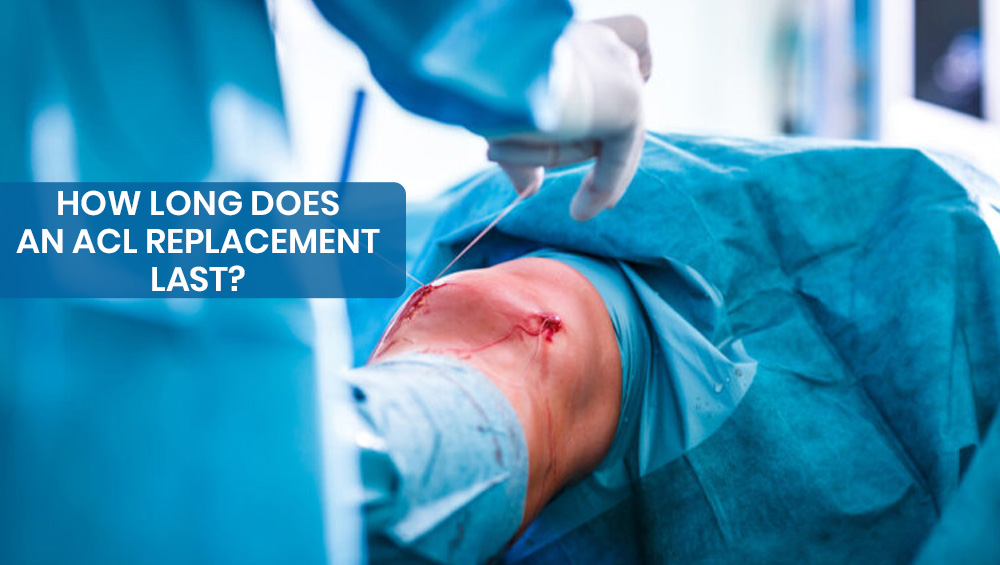
ACL injuries are frequent, particularly for those who love sports or who have an active lifestyle. After an injury has occurred, there are two issues that will be raised: "Will my knee ever be the same?" and "How long do I have to wait for the procedure?" These questions are quite normal and show the necessity of knee stability in everyday life.
The most straightforward answer is that an effective ACL replacement is intended to last for a long time. When it heals, it will not "expire" like a synthetic part. A lot of people lead a healthy and active life with the same ligament that was reconstructed for a long time.
This blog explains how long an ACL replacement lasts, the key factors that affect its longevity, success rates, long-term recovery, and lifestyle tips to protect your knee. Selecting the right surgeon is important in order to ensure proper evaluation and treatment. A large number of patients are looking for the best orthopedic doctor in Noida.
The "Lifespan" of an ACL Replacement: A Permanent Solution
If you're concerned what the length of time an ACL replacement lasts, the comforting reality is that an ACL transplant isn't a synthetic implant that wears down in time. After surgery, the graft will slowly become a part of your body and will eventually develop into living tissue. This is why the duration is very long. This is why the ACL surgery lifespan is considered long-term.
The body is undergoing a natural process called ligamentization. At this point, the graft develops into an extremely strong and natural-feeling ligament. When the graft heals, it functions exactly like the old ACL. It allows for stability and provides support. If taken care of properly, the ACL reconstruction longevity is often lifelong.
Long-Term Success Rates and Durability
The most important concern for people is whether or not the new ligament will be strong in time. Research shows that the ACL graft lifespan is excellent. Studies have shown that 89% results at 15 years old of use, which shows how durable the procedure is.
Many athletes return to high-level activities and can maintain knee stability for years. The long-term results after ACL surgery demonstrate that the reconstructed ligament is robust in the event of no further accident or injury. The procedure provides stability for a long time when paired with good rehabilitation and knee protection.
Factors That Influence ACL Graft Success and Lifespan
Your ACL reconstruction may last a lifetime. However, many factors are in the equation when it comes to how well the graft heals as well as performs. These are the most important elements that affect the outcome in ACL surgery:
1. Operative Technique
An accurate procedure is, therefore, of the utmost importance. The graft must be placed in the right anatomical position in order to ensure stability over the long term in the knee.
2. Graft Type
There are two kinds:
Autograft is a tissue that you have extracted from your own body
Allograft obtained from a donor
Autografts are always stronger, especially for active, young patients.
3. Rehabilitation is the most significant factor
The process of recovery following ACL reconstruction greatly relies on physiotherapy. It is vital to adhere to an effective exercise program that strengthens the muscles around your knee. A significant portion of the factors affecting ACL surgery success depend on how thoroughly you take your rehabilitation program.
A lot of patients seek advanced rehabilitation assistance from a specialist ACL Reconstruction in Noida to make sure that proper healing is achieved and a full functional recovery.
4. Activity Level
If you decide to return to high-impact sports, such as basketball, football, or badminton, you'll have the possibility of injury to yourself. Sports with lower impact that require less impact are safer and can assist in ensuring the safety of the transplant.
5. Patient Factors
Weight, age, general health, and strength can affect the graft's longevity. Younger patients typically have more frequent re-tears due to their greater intensity of exercise.
What Can Cause an ACL Graft to Fail?
Both kinds of grafts may be strong that last for a long period of time, but the ACL graft failure rate is generally low. Your physician will assist you in selecting the appropriate one for you based on your body's needs.
A failure in an ACL graft is extremely rare, and the ACL Graft's failure rate is usually minimal. The graft doesn't fail due to wear and tear, but fails mostly because of external causes.
- New Trauma or Re-injury: It is the most typical reason for failure. An unexpected twist or fall, or a sports injury, could damage the graft.
- Technical Errors: In some instances, a graft might be ineffective due to incorrect surgical placement.
- Poor Rehab: If the muscles surrounding the knee are weak, then the knee joint will remain in a state of instability. This increases the risk of an injury occurring in the future.
If the graft is not successful, then the most common treatment is ACL revision surgery, in which the ligament is repaired to give stability. Constitution as well as the level of physical level of physical.
Frequently Asked Questions (FAQs)
1. What happens if my ACL repair wears out with time?
No. Once the graft is healed, it changes to living tissue. It isn't damaged, but a wound that occurred in the past could alter the graft.
2. Can I continue playing sports such as basketball or football following surgery?
Yes. Numerous players resume their sports after an entire recovery. There is an increased risk of suffering a recurrence.
3. Does the time-to-live differ for patellar or hamstring tendon transplants?
Both types of grafts can be strong that last for a long period of time. Your physician can assist you in selecting the best one for your health and the degree of physical activity.
4. What is the timeframe for recovery for a normal ACL reconstruction?
It is possible to return to sport within 6 to 9 months, but full-force training can take a year or longer. It is vital to keep active for a long time to maintain strength.
Conclusion and Call to Action
If properly performed and supported by proper rehabilitation If it is done correctly, an ACL reconstruction can be durable and long-lasting. A lot of people can maintain strong knees for a long time, and the life span for ACL reconstruction is long. The secret to enduring success is determination to strengthen, heal, and avoid injury.
If you are experiencing pain in your knee or are seeking expert advice on ACL Reconstruction, talk to Dr. Yugal Karkhur, the Best Orthopedic Surgeon in Noida, having experience over 14 years.
Schedule your appointment to take the first step toward an incredibly stable, strong knee.