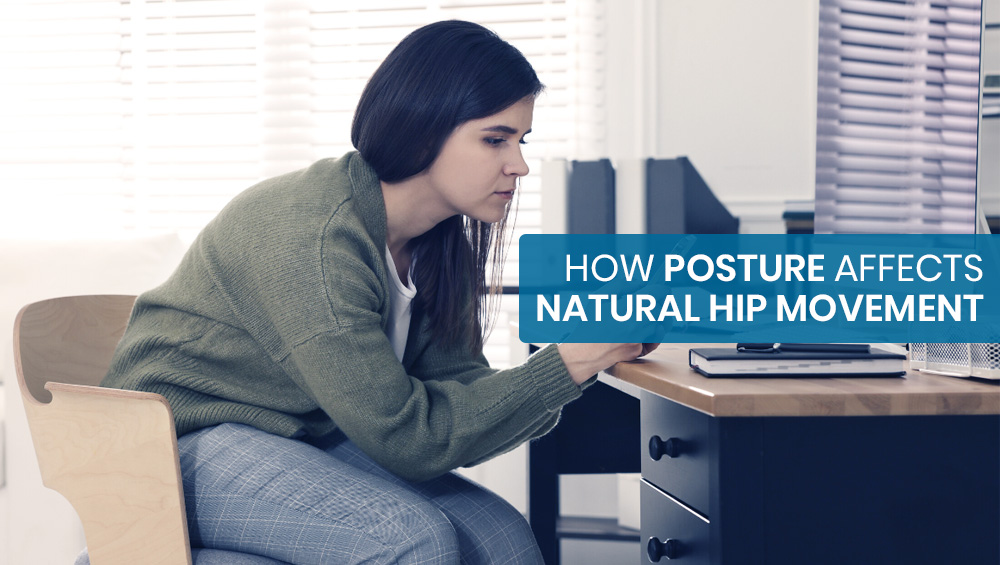
Do you feel stiff in the hips or lower back with a dull ache when you sit for a long time and then stand up? The majority think that such conditions are due to age or fatigue. However, the issue actually lies in how posture affects hip movement. The relationship between hip movement and posture is much more complicated than just “standing straight.” Your posture has a direct impact on the way your hips move, the activation of your muscles, and even the alignment of your pelvis. When posture starts to get worse, your hips are often the first body parts that will show it.
The current blog is all about the relationship between posture and hip mobility, the effect of posture on hip alignment, and the emergence of problems like anterior pelvic tilt and hip mobility, which are quite common, helping you to realize the whole kinetic chain and what you can do to realign it.
The Kinetic Chain: Hips as Your Body’s Foundation
Imagine the body's structure as a system, where each joint impacts the next. The hips are situated at the center of the chain of joints and are an integral part of the support structure, performing the majority of your movements along with them. The hip joint, being the largest ball-and-socket joint of the human body, takes the burden of almost half your total body weight every step you take. Hence, natural hip movement and body alignment are necessary for even the simplest of activities, such as walking comfortably and maintaining strong posture, all of which are interrelated.
The moment your pelvis tilts, rotates, or shifts out of its original position, your entire body will try to make up for the loss by doing opposite actions on the different parts. Your spine may take on an unusual curve, your knees may turn inwards, or your ankles may give in during motion. The disturbance in hip stability and posture directly affects balance, strength, and movement efficiency in general. To put it very simply, it is all about pelvis alignment and hip function; if one is unaligned, the other one has to bear the struggles again.
Common Postural Problems and Their Effects on Hips
Postural deviations are a lot more common than one would think, and to a large extent, they have become a part of today's lifestyle. The most common postural problems will be discussed next in relation to hip mobility and alignment.
1. Prolonged Sitting or Slouching
A lot of people today spend a lot of time in a slouched, prone position using their laptops or lying on a sofa. Over a period of time, it leads to sitting posture and hip tightness, especially of the hip flexors. The shortening of these muscles. You develop hip flexor tightness from poor posture.
One can soon experience weak glutes and an exhausted core, leading to muscular imbalance. This is one of the major instances of how posture affects hip movement, since the entire body has to adapt to an unhealthy pattern just to keep you standing up.
2. Anterior Pelvic Tilt (APT)
APT occurs when the pelvis tilts forward, which in turn increases the lower back's curve. It is very prevalent among people who work in offices, who are new to exercise, and those who have been sitting for a long time.
A pelvis that is tilted forward does not allow the hip to be extended to its full range, so even walking feels like a stiff or awkward movement. This is the reason anterior pelvic tilt and hip mobility problems very often result in lower back pain, tightness in the hamstrings, and pressure in the hip flexors, getting even more increased. The impact of this issue on alignment is such that it eventually enters the comfort domain of the person concerned.
3. Swayback Posture or Uneven Standing
To some extent, there are individuals who unintentionally put their weight on one leg or adopt a posture with their hips pushed forward. This, in turn, results in unequal pressure distribution and interrupts the smooth rhythm of one's walking action.
The strangeness between the two sides and the significance of posture on hip alignment are gradually revealed as the process of getting used to this continues. The inevitable result is a vicious cycle of unbalanced damage and fatigue, muscular strain, and compensatory patterns that eventually result in the feeling of unstable or sore hips. This is why it is clearer how important the relationship between posture and hip mobility is, and why alignment is still vital.
Real-World Consequences of Restricted Hip Movement
The direct link between the hip movement and posture connection itself is through the fact that, during the performance of daily activities, the everyday movements start to feel more difficult. Quite often, people whose posture is not proper complain of the same pain in the lower part of their backs, knees, and even discomfort when doing such basic things as squatting or climbing stairs. Restricted hip mobility, over time, will lead to cartilage strain, joint degeneration, and even increased osteoarthritis risk. This is a situation in which the effect of slouching affects the hips, and it is the main reason why proper posture and hip function must be maintained for the long term in musculoskeletal health.
How to Restore Natural Hip Movement
Restoration of hip mobility and proper alignment does not need to be completely changed. Little, consistent habits will be very helpful indeed.
- Postural Awareness: Make use of soft reminders to improve your posture, stop slouching, and maintain a balanced weight of both your feet.
- Ergonomics: Make sure your chair, computer, and sitting position are such that they do not cause hip flexor tightness from poor posture.
- Movement & Stretching: Very easy and plain movements, such as hip flexor stretches, glute bridges, and slow mobility drills, can rejuvenate hip stability and posture in a natural way.
Just a couple of minutes of deliberate movements done daily can lead to a considerable improvement in the natural hip movement and body alignment of the body.
When to See a Specialist
Persistent hip pain or stiffness is a condition that should always be treated seriously. Consulting the best orthopaedic surgeon in Delhi NCR for an accurate assessment and individualized therapy may be the only solution if the symptoms continue for several weeks or even start to disturb your daily life. Early diagnoses are particularly critical for diseases such as AVN. If you have any doubts about the symptoms, like severe hip pain or limitation of motion, do not hesitate to check AVN treatment in Delhi NCR in order to avoid issues related to the long term.
Conclusion
Healthy hips, functionally, begin with posture that is healthy posture. Along with proper daily activities, body awareness, and timely medical consultation, you may be free of pain-causing movements and eliminate the chances of similar incidents occurring in the future. For assistance from an expert, you may visit Dr. Yugal Karkhur, with over 14 years of experience, the best orthopedic surgeon in Gurgaon.