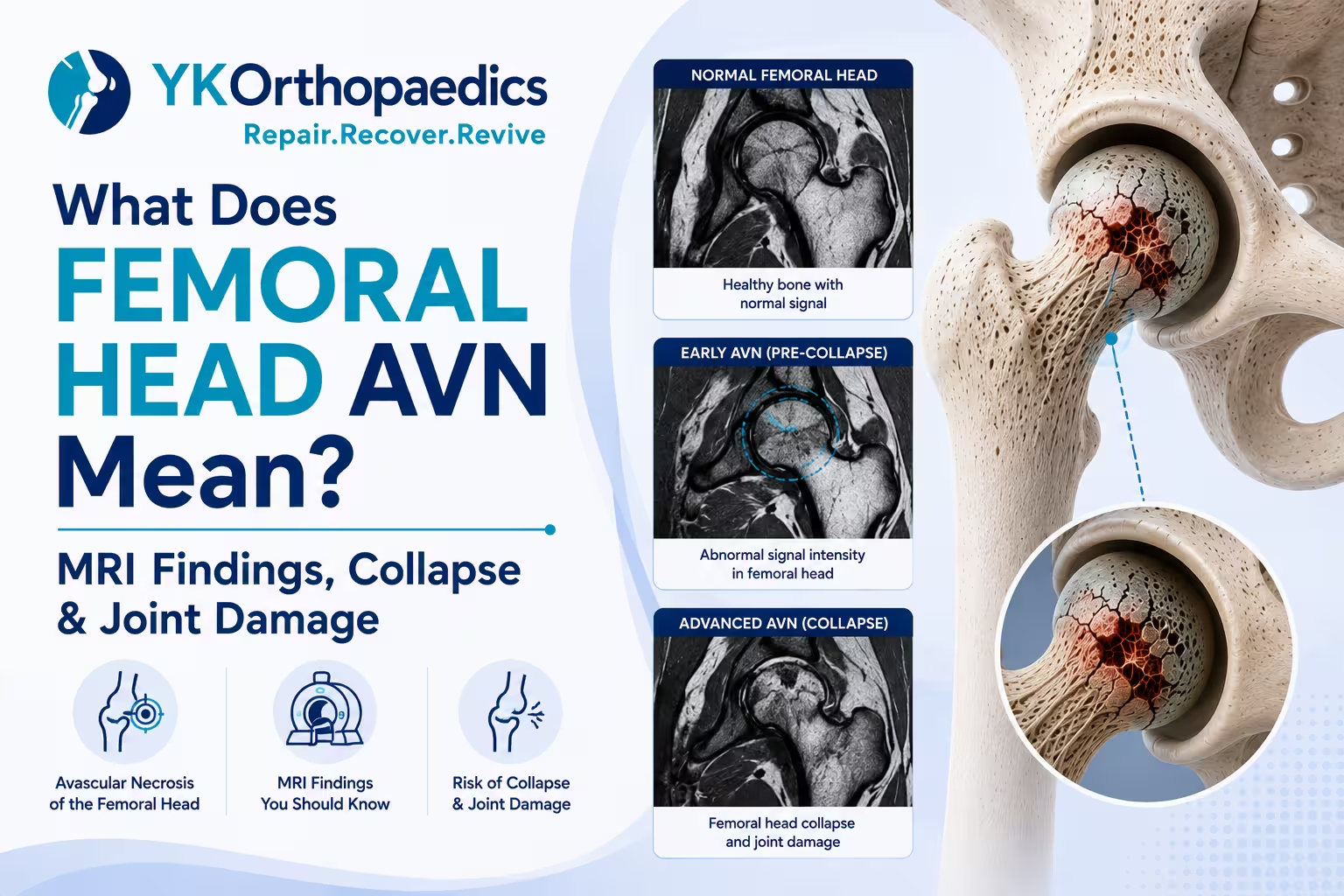
Femoral head AVN means that the bone forming the ball of the hip joint has been damaged because of inadequate blood supply. Early AVN may be visible on MRI even when an X-ray is normal. If the condition progresses, the weakened femoral head can develop a subchondral fracture and collapse. Advanced collapse with joint damage may eventually require total hip replacement.
What Is the Femoral Head?
The femoral head is the rounded upper end of the thigh bone, or femur.
It fits into the hip socket to form the ball-and-socket hip joint.
The femoral head needs a healthy blood supply to maintain normal bone tissue. When that blood supply is disrupted, osteonecrosis or AVN can develop.
Because the femoral head carries substantial weight during standing and walking, damage in this area can eventually affect the entire hip joint.
What Causes Femoral Head AVN?
AVN can develop because of several different factors.
Common risk factors include:
Long-Term Corticosteroid Use
Long-term or high-dose corticosteroid use is an important risk factor for osteonecrosis.
Excessive Alcohol Consumption
Long-term excessive alcohol consumption is another recognized risk factor.
Previous Hip Injury
A hip fracture or dislocation can damage blood vessels supplying the femoral head and lead to traumatic osteonecrosis.
Blood Disorders
Conditions such as sickle cell disease can increase the risk of AVN.
Autoimmune Diseases
Conditions such as lupus can be associated with osteonecrosis, with both the disease and its treatment potentially contributing to risk.
Other Conditions
Certain cancers, gout, pancreatitis, Gaucher disease and HIV infection have also been associated with osteonecrosis.
Sometimes, no clear cause can be identified.
What Are the Symptoms of Femoral Head AVN?
Symptoms depend on the stage and extent of disease.
Early AVN may produce:
- No symptoms
- Mild hip pain
- Groin pain
- Pain while walking
- Pain after physical activity
- Mild stiffness
As the disease progresses, symptoms may include:
- Persistent hip pain
- Pain while standing
- Pain at rest
- Reduced hip movement
- Limping
- Difficulty walking
- Difficulty climbing stairs
- Difficulty performing everyday activities
Hip AVN commonly causes pain around the groin, although discomfort may also extend into the thigh or buttock.
Can Femoral Head AVN Have No Symptoms?
Yes.
Early osteonecrosis may not cause noticeable symptoms.
This is one reason AVN can sometimes be discovered during imaging performed because of a risk factor or because the opposite hip is symptomatic.
Therefore, pain severity does not reliably tell you how advanced AVN is.
Imaging is important for determining whether structural damage or collapse has occurred.
What Does Femoral Head AVN Look Like on MRI?
MRI can identify AVN before many changes become visible on X-ray.
A typical AVN lesion may appear as an abnormal geographic or serpiginous area within the femoral head.
Your MRI report may mention terms such as:
- Serpiginous lesion
- Geographic abnormality
- Abnormal bone marrow signal
- Double-line sign
- Bone marrow edema
- Subchondral fracture
- Crescent sign
- Femoral-head collapse
MRI is particularly useful because it can detect early osteonecrosis and show the extent of the affected area.
What Does the "Double-Line Sign" Mean?
The double-line sign is a characteristic MRI feature associated with osteonecrosis.
It describes a specific pattern at the border of the affected bone on MRI.
If your report mentions a double-line sign, it supports the diagnosis of AVN.
However, the double-line sign alone does not determine the AVN stage.
Doctors also consider whether there is a subchondral fracture, femoral-head collapse and joint degeneration.
What Does "Serpiginous Lesion" Mean?
If your MRI report says:
"Serpiginous lesion in the femoral head"
the term serpiginous describes the winding or irregular appearance of the boundary of the affected bone.
It is commonly used when describing osteonecrosis.
The more important questions are:
- How large is the lesion?
- Where is it located?
- Does it involve the weight-bearing portion?
- Is there a fracture?
- Has collapse occurred?
What Does "No Femoral Head Collapse" Mean?
If the MRI says:
"No evidence of femoral head collapse."
this means that significant structural collapse has not been identified.
This is generally an important finding because joint-preserving treatment is more feasible before substantial collapse occurs.
However, it does not mean the AVN can be ignored.
The size and location of the lesion still influence the risk of future progression.
What Is Femoral Head Collapse?
The femoral head normally has a smooth, rounded shape.
When AVN weakens the bone sufficiently, the supporting bone beneath the joint surface can fail. The femoral head may then:
- Flatten
- Become irregular
- Lose its spherical shape
- Develop a subchondral fracture
- Collapse
This can interfere with the normal mechanics of the hip joint.
Once collapse occurs, the risk of secondary joint degeneration increases.
What Does "Subchondral Fracture" Mean in Femoral Head AVN?
A subchondral fracture is a fracture located just beneath the cartilage-covered joint surface.
It indicates that the weakened bone has started to fail structurally.
Your MRI report may also mention a crescent sign, which is associated with this type of structural failure.
This finding is important because it indicates more advanced disease than AVN without collapse.
What Is the Crescent Sign?
The crescent sign refers to a subchondral fracture that develops beneath the articular surface of the femoral head.
It is an important imaging finding in progressive AVN.
If your MRI report mentions:
"Crescent sign"
or
"Subchondral fracture"
you should discuss the finding with an orthopedic specialist because it can influence staging and treatment decisions.
How Is Femoral Head AVN Classified by Stage?
Different classification systems are used, including Ficat and ARCO, so the exact terminology can vary between reports.
A simple way to understand the progression is:
| Stage | General Meaning |
|---|---|
| Stage 1 | Early AVN; X-ray may still be normal |
| Stage 2 | Bone changes visible, but no significant collapse |
| Stage 3 | Subchondral fracture and/or femoral-head collapse |
| Stage 4 | Collapse with secondary arthritis/joint degeneration |
This is a simplified explanation. Your orthopedic specialist should determine the precise stage using the classification system applicable to your imaging.
What Is Stage 1 Femoral Head AVN?
Stage 1 represents early disease.
MRI may show AVN even when:
- X-ray is normal
- Symptoms are mild
- No femoral-head collapse is present
This stage can provide an opportunity to consider joint-preserving treatment in appropriately selected patients.
What Is Stage 2 Femoral Head AVN?
At Stage 2:
- AVN is visible on imaging.
- Bone structural changes are present.
- The femoral head has not significantly collapsed.
- The joint surface may still be preserved.
The size and location of the lesion are important when assessing the risk of progression.
What Is Stage 3 Femoral Head AVN?
Stage 3 indicates structural failure.
MRI or X-ray may show:
- Subchondral fracture
- Crescent sign
- Femoral-head collapse
- Change in femoral-head contour
Treatment becomes more dependent on the extent of collapse and condition of the joint.
What Is Stage 4 Femoral Head AVN?
Stage 4 represents advanced disease with:
- Significant femoral-head collapse
- Flattening or deformity
- Cartilage damage
- Secondary osteoarthritis
- Joint-space narrowing or other degenerative changes
When pain and disability are significant, total hip replacement may be considered.
Does Femoral Head AVN Always Cause Collapse?
No.
Not every AVN lesion progresses to collapse.
Small lesions, particularly those outside major weight-bearing regions, may sometimes remain stable or heal. Larger lesions involving weight-bearing areas have a greater risk of collapse.
Therefore, the presence of AVN does not automatically mean that hip replacement will be necessary.
Why Does the Size of Femoral Head AVN Matter?
The size of the lesion can influence the risk of progression.
Small Lesion
A small lesion may have:
- Less bone involvement
- Lower mechanical stress
- Better chance of remaining stable
Large Lesion
A large lesion may:
- Involve more of the femoral head
- Affect the weight-bearing surface
- Have a greater risk of collapse
However, size alone does not determine the outcome.
Location and structural condition are equally important.
Why Does Weight-Bearing Area Matter?
The weight-bearing portion of the femoral head experiences significant forces whenever you stand or walk.
If AVN affects this region, the weakened bone has to withstand repeated mechanical loading.
Therefore, an AVN lesion involving the weight-bearing surface may have a greater risk of collapse than a lesion in a less mechanically stressed region.
Can Femoral Head AVN Affect Both Hips?
Yes.
AVN can affect both femoral heads, particularly when associated with systemic risk factors.
The two hips may not be at the same stage.
For example:
Right hip: Stage 2 AVN without collapse
Left hip: Stage 3 AVN with collapse
This means the treatment plan may be different for each hip.
If AVN is diagnosed in one hip, your orthopedic specialist may evaluate the other hip depending on your symptoms and risk factors.
What Happens If Femoral Head AVN Is Left Untreated?
Progressive AVN can lead to:
Bone damage → Subchondral fracture → Femoral-head collapse → Cartilage damage → Secondary arthritis
As the hip deteriorates, you may experience:
- Increasing pain
- Stiffness
- Limping
- Reduced walking ability
- Reduced range of motion
- Difficulty with daily activities
Advanced joint damage may eventually require hip replacement.
Can Femoral Head AVN Be Treated Without Surgery?
Selected early cases can initially be managed without surgery.
Depending on the individual situation, treatment may include:
- Activity modification
- Protected weight-bearing
- Pain management
- Physiotherapy
- Treatment of underlying risk factors
- Regular monitoring
However, these measures cannot reliably reverse established femoral-head collapse.
When AVN has progressed significantly, surgical treatment may be necessary.
What Is Core Decompression for Femoral Head AVN?
Core decompression is a joint-preserving surgical procedure used in selected patients with early-stage AVN.
The procedure creates channels within the affected bone with the aim of reducing pressure and promoting healing.
It is generally more suitable before significant femoral-head collapse.
Whether it is appropriate depends on:
- Stage
- Lesion size
- Lesion location
- Symptoms
- Patient age
- Overall health
When Is Hip Replacement Needed for Femoral Head AVN?
Total hip replacement may be considered when:
- Significant femoral-head collapse has occurred.
- Secondary arthritis has developed.
- Pain is persistent or severe.
- Walking is significantly affected.
- Hip movement is substantially restricted.
- Joint-preserving treatment is unlikely to provide adequate benefit.
The decision is based on the overall condition of the hip rather than the stage number alone.
Can Femoral Head AVN Be Reversed?
Early disease may sometimes remain stable or heal, particularly when the lesion is small.
However, established femoral-head collapse generally cannot be reversed with medicines, exercises or home remedies.
Once advanced joint degeneration develops, treatment usually focuses on restoring function and reducing pain rather than trying to restore the original shape of the collapsed femoral head.
How Is Femoral Head AVN Diagnosed?
X-Ray
X-rays are commonly used as an initial test.
They can show advanced structural changes but may appear normal in early AVN.
MRI
MRI is particularly useful for:
- Detecting early AVN
- Measuring the extent of the lesion
- Determining lesion location
- Identifying subchondral fracture
- Assessing femoral-head collapse
- Evaluating the opposite hip
CT Scan
CT may be used in selected cases to provide additional information about bone structure and the extent of collapse.
What Should You Look for in a Femoral Head AVN MRI Report?
If you have an MRI report, look for these terms:
Earlier/less advanced findings
- "AVN"
- "Serpiginous lesion"
- "Geographic lesion"
- "No collapse"
- "No subchondral fracture"
- "Joint surface maintained"
More advanced findings
- "Subchondral fracture"
- "Crescent sign"
- "Femoral-head collapse"
- "Flattening"
- "Deformity"
- "Secondary osteoarthritis"
- "Joint-space narrowing"
These findings can provide clues about disease severity, but the complete MRI should be reviewed by an orthopedic specialist.
When Should You See an Orthopedic Doctor?
You should consider an orthopedic evaluation if you have:
- Persistent hip or groin pain
- An MRI showing femoral-head AVN
- Increasing difficulty walking
- Hip stiffness
- Reduced range of motion
- Known AVN in one hip
- A history of long-term steroid use
- Previous hip fracture or dislocation
- Increasing pain despite conservative treatment
Early evaluation can be particularly important because joint-preserving treatment is generally more feasible before significant collapse.
Expert Opinion
According to Dr. Yugal Karkhur, a Best Orthopedic Doctor in Gurgaon, femoral head AVN should be evaluated by looking at more than the presence of osteonecrosis on an MRI.
The key questions are how much of the femoral head is affected, whether the weight-bearing portion is involved and whether there is a subchondral fracture or collapse.
Early AVN may offer an opportunity for joint-preserving treatment in appropriately selected patients. Once significant femoral-head collapse and secondary arthritis have developed, total hip replacement may become the more reliable treatment option.
Conclusion
Femoral head AVN means that the bone forming the ball of the hip joint has been damaged because of reduced or interrupted blood supply. MRI is one of the most useful tests for identifying AVN early and determining the size, location and structural condition of the affected bone.
The most important MRI findings are lesion size, weight-bearing involvement, subchondral fracture and femoral-head collapse. Early AVN without collapse may have joint-preserving treatment options, while advanced collapse with secondary arthritis may require total hip replacement.
If you are looking for a Best Orthopedic Doctor in Gurgaon, Dr. Yugal Karkhur can evaluate your MRI, assess the stage and extent of femoral-head AVN and recommend an appropriate treatment approach.
FAQs
What does femoral head AVN mean?
Femoral head AVN means that part of the femoral head has been damaged because its blood supply has been reduced or interrupted.
Is femoral head AVN serious?
It can be serious if it progresses to femoral-head collapse and secondary arthritis. Early disease may have more opportunities for joint-preserving treatment.
What does femoral head AVN look like on MRI?
It commonly appears as a geographic or serpiginous area of abnormal bone marrow signal, sometimes with a characteristic double-line sign.
What does "no collapse" mean in femoral head AVN?
It means significant structural collapse of the femoral head has not been identified. This generally provides a better opportunity to consider joint-preserving treatment.
What does a subchondral fracture mean in AVN?
It means the weakened bone beneath the joint surface has developed a fracture, indicating structural progression of the disease.
What is the crescent sign in femoral head AVN?
The crescent sign represents a subchondral fracture and is an important imaging finding associated with progression of femoral-head osteonecrosis.
Can femoral head AVN affect both hips?
Yes. AVN can affect both hips, and the disease stage can be different in each hip.
Can femoral head AVN be cured without surgery?
Some early lesions may remain stable or heal, and selected patients can initially be managed conservatively. However, established femoral-head collapse generally cannot be reversed without addressing the damaged joint.
Does femoral head AVN always require hip replacement?
No. Early disease may be treated with joint-preserving approaches in selected patients. Hip replacement becomes more likely when significant collapse and secondary arthritis have developed.
Can a young person develop femoral head AVN?
Yes. AVN can affect younger adults, particularly when risk factors such as corticosteroid exposure, excessive alcohol consumption, trauma or certain medical conditions are present.