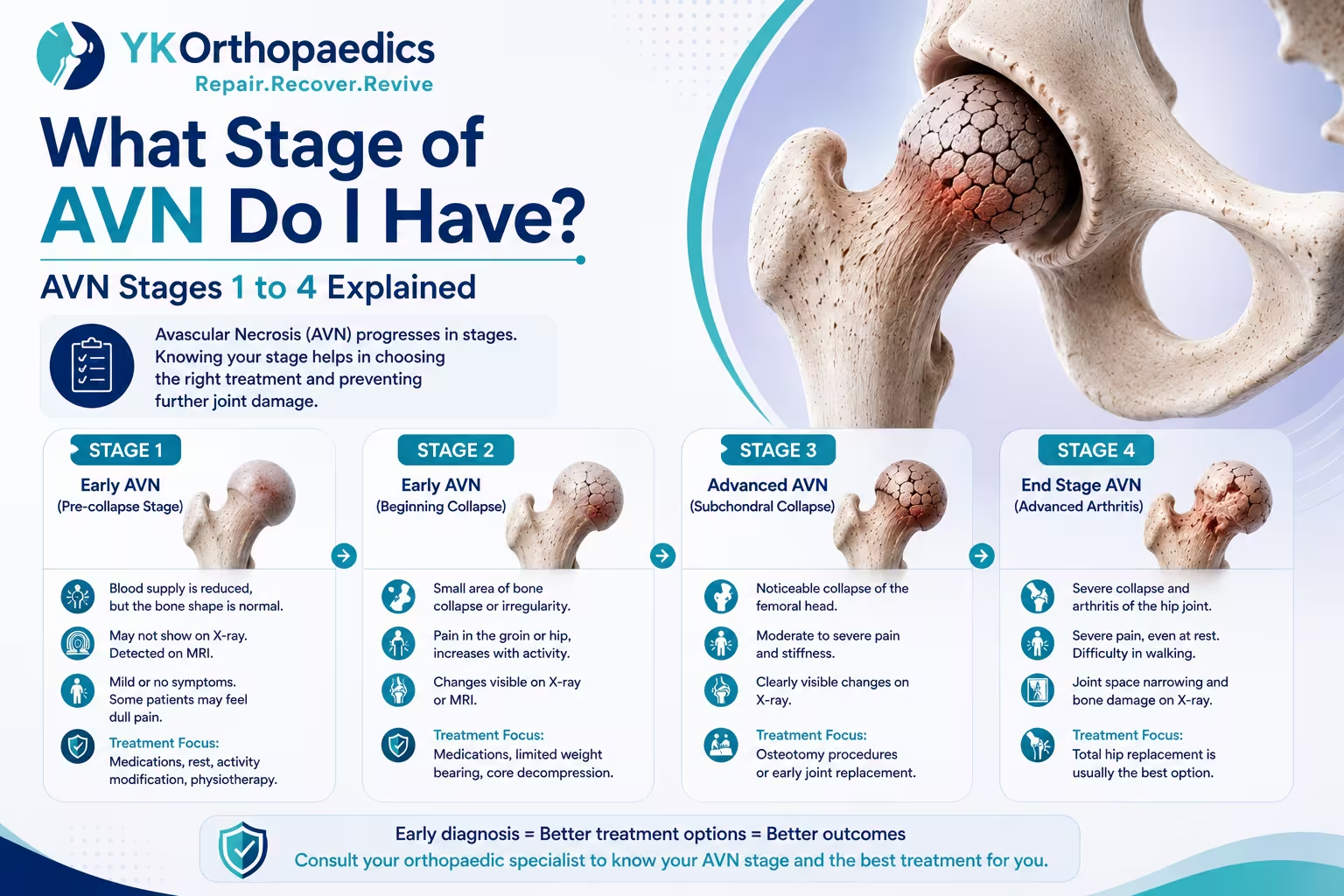
A simple way to understand AVN stages is:
| Stage | What is happening? | Typical imaging |
|---|---|---|
| Stage 1 | Early AVN; X-ray may appear normal | MRI detects changes |
| Stage 2 | Bone changes are visible but no collapse | X-ray/MRI abnormalities |
| Stage 3 | Bone begins to collapse | Crescent sign/subchondral collapse |
| Stage 4 | Advanced collapse with joint damage/arthritis | Degenerative changes |
The exact stage should be confirmed from your X-ray/MRI and orthopedic assessment.
AVN Stage 1: Early AVN
Stage 1 represents an early stage of osteonecrosis.
At this point, the blood supply has been disrupted and bone damage has started, but there may not yet be obvious structural collapse.
What might you feel?
Some people have:
- Mild hip or joint pain
- Pain during walking or activity
- Occasional groin pain
- No symptoms at all
Early AVN can be difficult to identify because symptoms may be minimal or absent.
What does the X-ray show?
An X-ray can still look normal in early AVN.
This is why MRI is important when AVN is suspected. MRI can detect osteonecrosis before changes become visible on X-ray.
Can Stage 1 AVN be treated?
Yes. Early diagnosis gives doctors more opportunities to consider joint-preserving treatment.
Depending on the individual case, options may include activity modification, protected weight-bearing, symptom management and, in selected patients, procedures such as core decompression.
AVN Stage 2: Bone Changes but No Collapse
In Stage 2, changes in the affected bone become visible on imaging, but the femoral head has not yet collapsed.
Possible imaging findings include areas of abnormal bone density or sclerosis.
Symptoms may include:
- Increasing hip pain
- Pain while walking
- Groin or thigh pain
- Stiffness
- Reduced activity tolerance
However, symptoms vary significantly between patients.
Why is Stage 2 important?
Stage 2 can still represent an important joint-preservation window, particularly when the lesion is suitable for treatment and the joint surface remains intact.
Core decompression is one of the procedures commonly considered for selected early-stage hip AVN.
AVN Stage 3: Bone Collapse Begins
Stage 3 is an important turning point because the weakened bone has begun to collapse beneath the joint surface.
In hip AVN, this can affect the shape of the femoral head.
Common symptoms
- More persistent hip pain
- Pain while standing or walking
- Increasing stiffness
- Reduced hip movement
- Limping
- Difficulty climbing stairs
As collapse progresses, normal joint movement can become increasingly difficult.
What is the Crescent Sign?
The crescent sign refers to a subchondral fracture that can occur in osteonecrosis.
Its presence indicates structural failure beneath the joint surface and is an important imaging finding in the progression of femoral-head AVN.
Can Stage 3 AVN be treated without replacement?
It depends on how much collapse has occurred, the size and location of the lesion, symptoms and overall joint condition.
Once substantial collapse has occurred, joint-preserving procedures become less predictable. Advanced structural damage may eventually require joint replacement.
AVN Stage 4: Advanced AVN
Stage 4 represents advanced disease, where AVN has progressed beyond bone damage and collapse to significant joint degeneration or secondary osteoarthritis.
Symptoms can include:
- Severe or persistent pain
- Pain even with minimal activity or at rest
- Significant stiffness
- Difficulty walking
- Limping
- Reduced hip movement
- Difficulty performing everyday activities
The joint may no longer function normally because both the bone and the joint surface have been damaged.
Is hip replacement needed in Stage 4?
When there is extensive femoral-head collapse and degenerative joint damage causing significant pain and disability, total hip replacement is generally the most reliable treatment for restoring function and relieving pain.
How Do I Know Which Stage of AVN I Have?
The most reliable way is through imaging and orthopedic evaluation.
X-Ray
X-rays are usually performed first. They can show later-stage AVN changes, but early disease can be missed.
MRI
MRI is particularly valuable because it can detect early AVN and show:
- Location of the lesion
- Extent of bone involvement
- Early structural changes
- Whether collapse has occurred
CT Scan
CT can sometimes provide additional information about the bone structure and help assess collapse, although MRI is generally more sensitive for early disease.
Can Pain Tell Me My AVN Stage?
No.
This is an important point.
A person with early AVN may have significant pain, while another person with more advanced disease may have surprisingly few symptoms.
Therefore, pain severity alone cannot determine whether you have Stage 1, 2, 3 or 4 AVN.
Your imaging findings are much more important for staging.
AVN Stage and Treatment at a Glance
| AVN Stage | Main Finding | Treatment Approach |
|---|---|---|
| Stage 1 | Early disease, often normal X-ray | Observation/conservative care or joint-preserving treatment in selected cases |
| Stage 2 | Bone changes without collapse | Joint-preserving treatment may be considered |
| Stage 3 | Subchondral fracture/collapse | Treatment depends on extent of collapse and joint condition |
| Stage 4 | Collapse + arthritis/joint damage | Joint replacement often considered |
This table is a simplified explanation. Actual treatment should be based on the specific staging system, lesion size and location, symptoms and imaging findings.
Does Stage 1 or Stage 2 AVN Always Get Worse?
No.
Small lesions, particularly those outside major weight-bearing areas, may sometimes heal or remain stable. However, larger lesions—especially those involving weight-bearing portions of the femoral head—have a greater risk of progression.
This is why early diagnosis does not necessarily mean that surgery is required. It means that there may be more treatment options available to preserve the natural joint.
Does Stage 3 or Stage 4 Always Mean Hip Replacement?
Not necessarily.
The decision depends on:
- Amount of bone collapse
- Size of the AVN lesion
- Location of the lesion
- Condition of the joint surface
- Presence of arthritis
- Pain and functional limitation
- Age and overall health
However, when extensive collapse and degenerative changes have developed, total hip replacement becomes the more reliable option for pain relief and restoration of function.
What If I Have AVN in Both Hips?
Bilateral AVN is possible, particularly with non-traumatic AVN.
Importantly, both hips do not necessarily have the same stage.
For example:
- Right hip — Stage 1 AVN
- Left hip — Stage 3 AVN
The treatment plan may therefore be different for each hip.
When AVN is suspected or diagnosed, imaging of both hips may be appropriate because early disease in the opposite hip can otherwise be missed.
When Should You See an Orthopedic Doctor?
Seek an orthopedic evaluation if you have:
- Persistent hip or groin pain
- Pain while walking or standing
- Increasing stiffness
- Difficulty walking
- A history of long-term steroid use
- Previous hip fracture or dislocation
- Known AVN
- AVN in one hip with symptoms in the other
Early diagnosis can increase the chance of successful treatment before significant joint collapse occurs.
Expert Opinion
According to Dr. Yugal Karkhur, a Orthopedic Doctor, the most important question after an AVN diagnosis is not simply "What stage do I have?" but also "Has the femoral head collapsed, and how much of the bone is affected?"
Early-stage AVN may provide an opportunity for joint-preserving treatment, while advanced collapse with arthritis may require joint replacement. Accurate MRI assessment and clinical evaluation are therefore essential for selecting the right treatment.
Related Services
- Knee Replacement
- Hip Replacement
- ACL Reconstruction
- Meniscus Repair
- Carpal Tunnel Surgery
- Partial Knee Replacement
- Knee Arthroscopic Surgery
- AVN Treatment
Related Articles
- AVN Stage 1 Meaning
- AVN Stage 2 Meaning
- AVN Stage 3 Meaning
- AVN Stage 4 Meaning
- How Quickly Does AVN Progress?
Conclusion
AVN stages are mainly determined by imaging, not by pain severity. In simple terms, Stage 1 and Stage 2 represent earlier disease where the joint surface has not undergone major collapse. Stage 3 involves subchondral collapse, while Stage 4 represents advanced collapse with secondary joint degeneration.
The earlier AVN is identified, the more opportunity there may be to consider treatments aimed at preserving the natural joint. Once significant collapse and arthritis have developed, joint replacement may become necessary.
If you are looking for a Best Orthopedic Doctor in Gurgaon, Dr. Yugal Karkhur can evaluate your X-ray or MRI, determine the stage and discuss the most appropriate treatment options.
FAQs
How can I know what stage of AVN I have?
Your AVN stage is determined primarily through imaging, particularly X-ray and MRI, along with an orthopedic evaluation.
Is Stage 1 AVN serious?
Stage 1 is an early stage, but it should not be ignored. Early evaluation may provide more opportunities for joint-preserving treatment.
Can Stage 2 AVN be cured?
Some small early lesions may stabilize or heal, but there is no guaranteed cure. Treatment depends on lesion size, location and other factors.
What happens in Stage 3 AVN?
The bone begins to collapse beneath the joint surface. This can cause increasing pain, stiffness and reduced joint movement.
Is Stage 4 AVN reversible?
Advanced bone collapse and secondary arthritis generally cannot be reversed with medicines or home treatment. Joint replacement may be considered when symptoms and joint damage are significant.
Does Stage 3 AVN always require hip replacement?
No. The need for replacement depends on the extent of collapse and the condition of the joint.
Which test is best for early AVN?
MRI is particularly useful because it can detect early osteonecrosis when X-rays may still appear normal.
Can AVN stage change over time?
Yes. AVN can progress, particularly when larger or weight-bearing lesions are involved. Follow-up imaging may be recommended to monitor the condition.